A Psychologist Explains the Hidden Loop Behind the Endless Mind Spiral
There is a moment almost everyone with a sensitive, analytical mind recognizes.
You are lying in bed. The room is quiet. Nothing is happening in the real world. But inside your head, everything is loud.
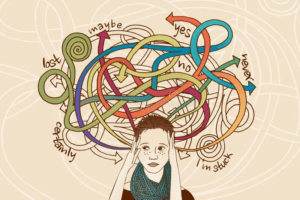
- A conversation from days ago is playing again.
- A decision from last year suddenly feels urgent.
- A sentence someone said echoes, breaks apart, and forms new meanings.
- You are not solving anything.
- You are circling. And yet, you cannot stop.
As a psychologist, I see this pattern every day. In my therapy room. In my clients’ stories. And sometimes, in myself.
We often call it overthinking, but that word is far too gentle for what is really happening.
Overthinking is not just “thinking too much.” It is a psychological loop — a silent, exhausting, invisible cycle that feels productive, while slowly draining your emotional energy.
And the most painful part?
Most people who overthink are not weak or irrational. They are often intelligent, conscientious, introspective, and deeply caring. Their mind is not broken. It is trying to protect them in the only way it knows how.
The hidden function of overthinking
Overthinking usually begins as a form of emotional self-protection.
At some point in your life, your mind learned that being alert, analyzing situations, predicting outcomes, and replaying scenarios could help you avoid pain. It helped you gain control when life felt uncertain or unsafe. It helped you prepare for criticism, rejection, or abandonment.
In that sense, overthinking was once adaptive. It was your mind’s way of saying:
“If I understand everything in advance, maybe nothing can hurt me.”
But over time, what once protected you begins to imprison you.
Instead of clarity, you get confusion.
Instead of solutions, you get mental noise.
Instead of safety, you get anxiety.
Your mind keeps searching for certainty in a world that cannot offer it. And the more it searches, the less peaceful you feel.
This is why overthinking feels both active and paralyzing at the same time.
The emotional roots beneath the thoughts
In my clinical experience, overthinking is rarely just about the thoughts themselves. It is almost always rooted in something deeper:
- Fear of making the wrong choice
- Fear of being misunderstood
- Fear of losing control
- Fear of not being enough
- Fear of being too much
Under the spiral of thoughts, there is usually a younger emotional part that is scared, unsure, and craving safety.
Many people try to stop overthinking by “thinking positively” or forcing their minds to be quiet. But the mind does not calm down through force. It calms down when it finally feels safe.
Overthinking is not a logic problem.
It is a safety problem.
Why some minds get trapped in the loop
Some people are more prone to overthinking than others, especially those who:
- grew up in unpredictable or highly critical environments
- had to become emotionally mature too early
- learned that love was conditional
- were praised for being smart but not held for being emotional
In these cases, the mind becomes the main source of comfort, control, and identity. Thinking becomes a way of surviving, not just a mental process.
So when you try to “stop overthinking,” it can feel like you are taking away a lifeline — even if that lifeline is hurting you.
What actually helps
Healing from overthinking does not start in the mind. It starts in the relationship you build with your own nervous system.
It is learning how to:
- notice when you are leaving the present moment
In my clinical experience, overthinking is rarely just about the thoughts themselves. It is almost always rooted in something deeper: Fear of making the wrong choice
Fear of being misunderstood
Fear of losing control
Fear of not being enough
Fear of being too muchUnder the spiral of thoughts, there is usually a younger emotional part that is scared, unsure, and craving safety.
- gently return without judgment
- feel the emotion instead of only analyzing it
- speak to yourself like someone who is worthy of care
In therapy, we do not fight the overthinking mind.
We listen to it. We understand it. And then we slowly teach it a new, safer way to exist.
A way that is not based on constant vigilance.
A way that does not require endless analysis to feel okay.
A way that allows you to live… instead of just mentally preparing to live.
A gentle truth to take with you
If you overthink, it does not mean something is wrong with you.
It means, at some point, your mind had to work very hard to keep you safe.
And now, it may be ready to rest